





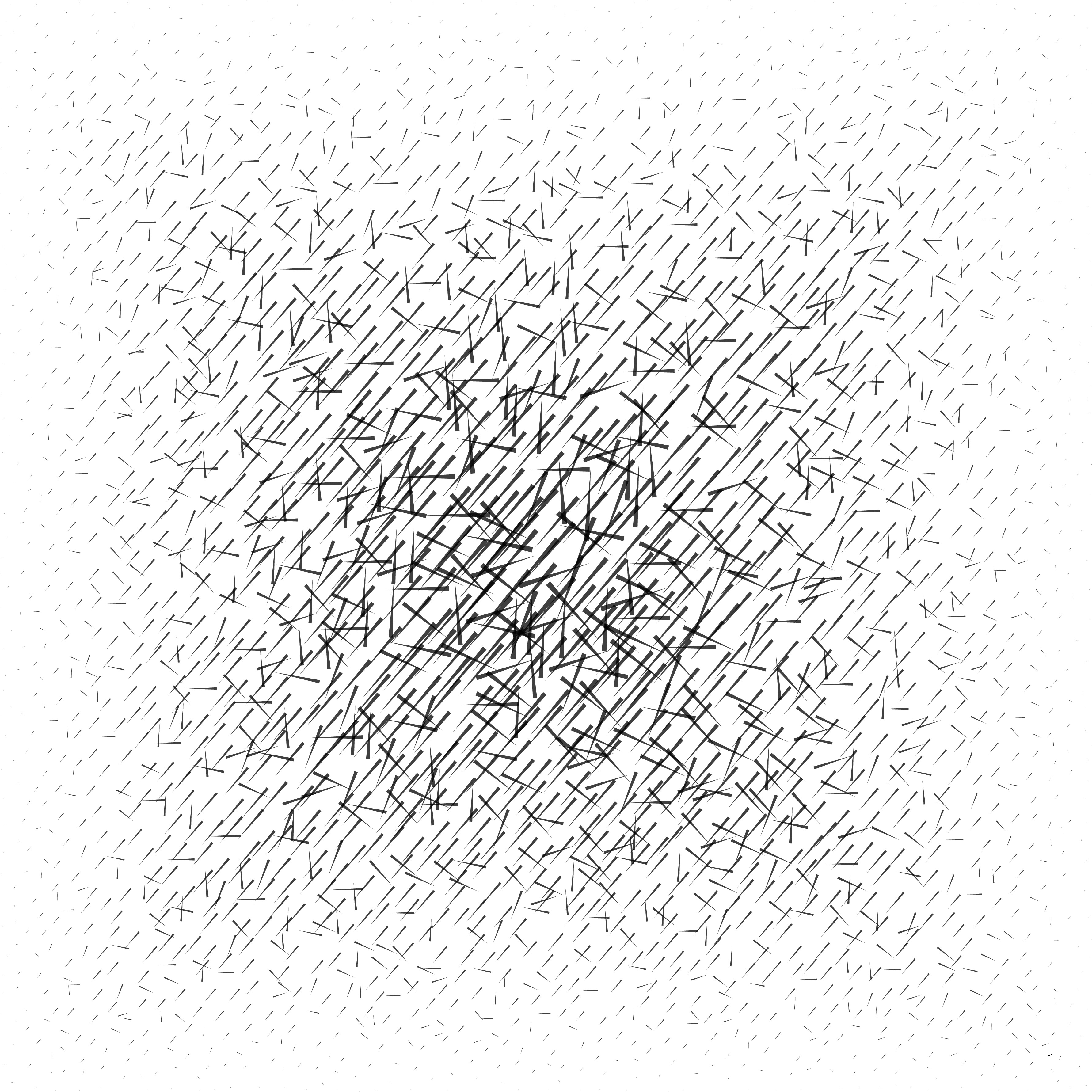
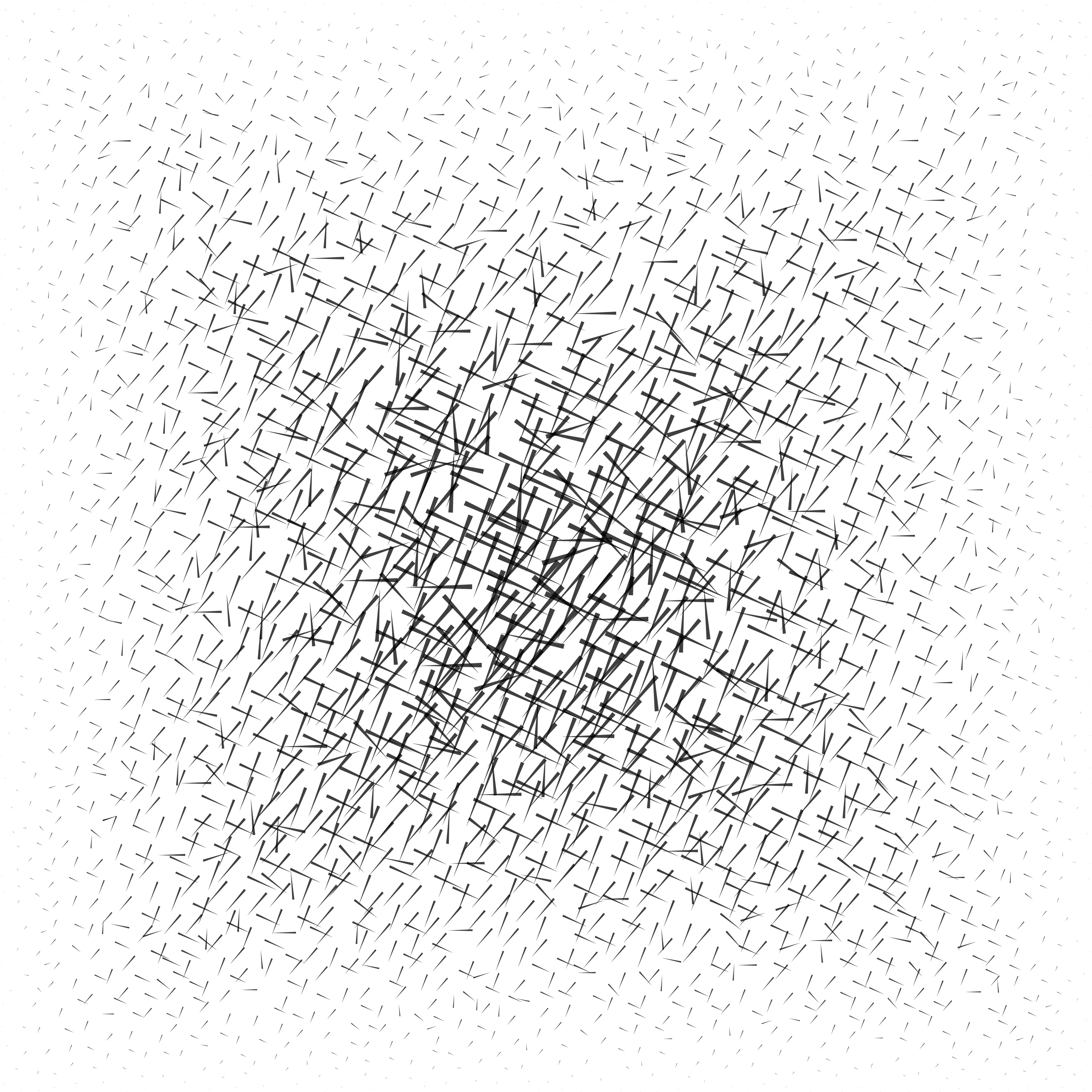
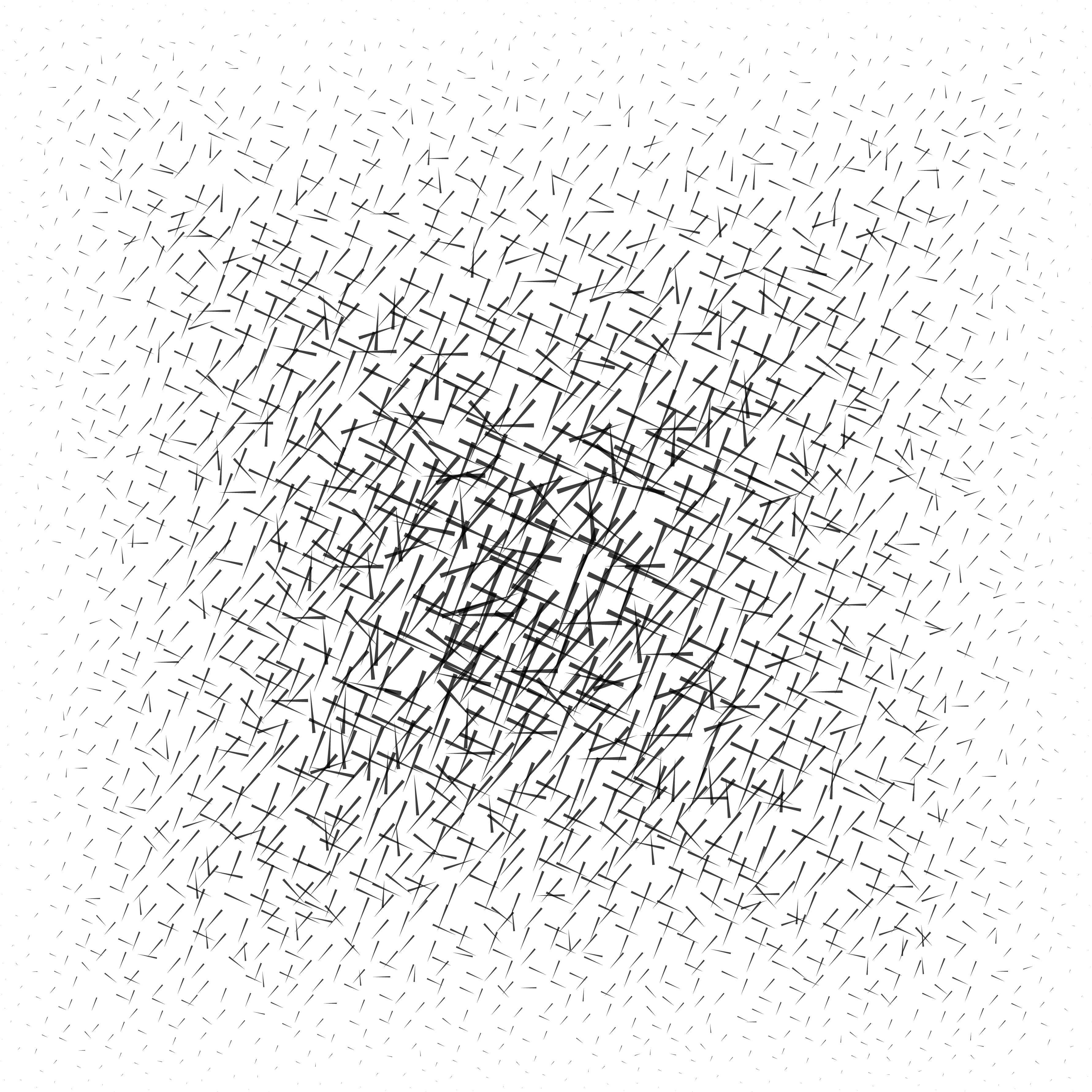








Presence and identity, in relation to sound, are based on change and difference. In audition, even characteristics like consistency, repeatability, or coherence are rarely based on exact replication or uniformity – instead, they are based on individual auditory elements, aligned through differentiating themselves in similar ways from a similar context. The animations shown on this page (a representation of the distribution of frequencies across the spectrum of human hearing), are an illustration of this. In the diagram at the right, although there is change, there is also enough similarity that the overall entity can be understood as in alignment. In the diagram at the left, an emergence of difference is shown – when the elements begin to rotate in a different direction from one another.
This model of presence and similarity can also be related to a consideration of individual participation and agency. Particularly in relation to the scenarios described by Christopher Schafer (“The City Is Unwritten: Urban Experiences And Thoughts Seen Through Park Fiction”) and Cowan et al. (“Making Their Own Plans”), ones in which issues of spatial agency, production, and occupation are critically significant, an argument can be presented that, while common goals must be established, too much of an emphasis on universality can eliminate differences and elevate the characteristics of a dominant group by considering it as normative. This is discussed at length by theorist Gayatri Chakravorty Spivak (“Can The Subaltern Speak?”). Spivak, as a linguist and translator, is making, amongst other, more complex and subtle arguments, an overarching one regarding the impossibility of neutrality, one which seems to imply the additional impossibility of interchangeability or completely identical value, meaning, or significance. A similar argument, one made specifically in relation to ideas of equity and participation within a spatial context, is made by James C. Scott (“Seeing Like A State: How Certain Schemes To Improve The Human Condition Have Failed”). Scott, in a section dealing with the link between property division, spatial occupation, and participatory rights, questions whether universalizing tendencies, when considered as prerequisite to democratic political participation, are in fact problematic in their demand for a kind of exchange value. In this sense, he is, perhaps, offering a spatial cognate to Spivak’s linguistic argument. In the arguments of both, then, can be seen a need for a model of coherence based on similarity and convergence, one which allows for both the individual and the collective to co-exist.