Photography & Industrialization
The Influence of Images in the Modern Era
The industrial revolution occurred in conjunction with a number of other massive changes in the social landscape worldwide. One of the greatest records that we have of this is the photography coming from government organizations and photojournalists alike. The spread of photographic information to the masses influenced and was influence by the social, economic, and political shift that took place during the late 19th and early 20th centuries.
The first truly impactful examples of this were the photos taken of factory and mill conditions, towards the beginning of industrialization. One of the most influential characters in this story was photographer Lewis Hine. His work with the Children’s Bureau took photographs intended to show the dreadful conditions which children were subjected to in industrial work.

Following the exposition photography of the early industrial revolution, many organizations such as the Women’s Bureau began photographing newer factory systems; both in an attempt to display improved working conditions, a positive reaction to the negativity of the earlier exposition photography.
Various government sectors and bureaus began following in these footsteps, contributing photo documentation to the U.S. National archives. In the 1930’s, New Deal publicity aimed at reinvigorating the American workforce and economy, developed a new, documentary style of photography and film, an attempt to limit the aspects of exposition which could be read as propaganda. New Deal photography, particularly that generated by the Farm Security Administration, was more focused on showing everyday people. Its target audience was no longer factory owners but the people themselves.
Many photographers, including Hine and those with the Social Security Administration, began work more geared towards publicity. The photographs taken had the aim of showing the American man in the throws of new capitalism. This was often in conjunction with the photographing of New Deal projects, such as dams and bridges. Both sides of the story were documented, the monumental projects and their construction, as well as the people and lifestyle being displaced by said monuments.

The advent of photo-magazines served only to increase the power of photography over public opinion. With the creation of Time magazine, so came the creation of Life by Luce, which proved to be a revolutionary publication in displaying the modernity of America.
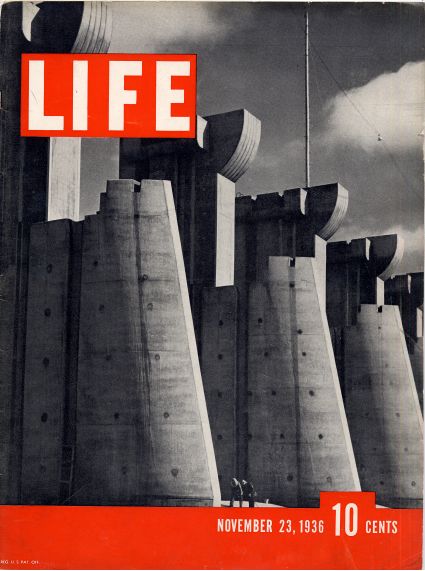
Ultimately, it can be understood that the role of photography during this time was not simply a display of the factories and farms, projects and people; it was an instrument of modernity. Photography was a tool, which communicated the shifting socio-economic landscape that came in conjunction with industrialization and new capitalism in modern America.
You can see more photos from this era here.